Category: New Energies

The Bridge Tank, a T20 member, participated in the G20 Summit in Hamburg

The Think20 (T20) is a network of research institutes and think tanks from the G20 countries. Its role is to provide policy recommendations to the G20. It also facilitates interaction between members and shares global issues through its blog.

The Bridge Tank, member of the T20, participated in the G20 Summit in Hamburg the 7th and the 8th of July and provided research-based policy briefs for the G20 Insights platforms that aims to support G20 policy making. The Bridge Tank has joined other expert think tanks in writing two policy briefs with the Climate Policy and Finance task force. One of those policy briefs got selected among the 20 best policy briefs that were presented during the G20 Summit. It analyses the role of innovative green-technology SMEs as an opportunity to promote financial de-risking.

To read those two policy briefs : http://thebridgetank.org/en/influence-we-shape/briefings-studies/

Ambitious mobility targets and industrial policy for India

India is ambitious. In order to reduce its CO2 emissions and to respond to urban air pollution issues, it announces, through the voices of its ministers of transport and energy, unprecedented green transition targets in the mobility sector: 22,5% biofuel and 100% electric vehicles by 2030. However, the measures that are supposed to ensure those ambitions seem to be weak, especially biofuels. The incorporation of biofuel ethanol, produced from sugar cane, also serves as a policy for reviving the sugar cane industry and energy independence; A program inspired by Brazil but whose example shows that it requires a coordinated industrial policy among the various sectors concerned. However, the weakness of the measures proposed by the Indian State is compounded by the difficulties of the domestic sugar cane industry and the demands of the domestic automotive industry, which is reluctant to invest in new production lines dedicated to ethanol vehicles.

The EV development program, although still unclear, looks to be better equipped politically and budgetary. However, it is not clear whether it is backed by a domestic industry development strategy or whether it is based on imports.

The green transition for countries in technological and industrial transition such as India cannot be based on the diffusion of imported technologies. Necessarily costly and requiring deep and sustained investment over the long term, it can only be sustainable if it is also the opportunity to accelerate and confirm a technological catch up that has already been well initiated in a specific field. The aim is to coordinate industrial policies with the climate and environmental objectives announced. Finally, new technologies complement one another and require, in order to be effectively deployed, a transversal, visionary industrial policy. The Indian market allows it, industry requires support but does public policy take the necessary measures?

Key points

The Indian objectives for transition to a low-carbon mobility are ambitious but for the moment the measures announced by the government to achieve them are weak.

India’s ability to achieve its objectives requires a more calibrated industrial policy.

Development

India draws inspiration from Brazil for its ambitions in biofuels

Nitin Gadkari, Minister of Road Transport and Highways, told the Indian press that the blending rate for ethanol is expected to increase to 22.5% and that for biodiesel to 15% by 2030. A transition motivated by the objective of reducing urban air pollution but also and above all supporting the sugar cane industry and strengthening India’s energy security. The Minister refers to a strategy of broad diversification of the markets of the agricultural industry towards electricity and bioplastics; Similar to the one that has proved its worth in Brazil and which is inspiring for the minister.

Indeed, in this field, the current Indian context is comparable to that of Brazil in the 1970s, when excess sugar cane production was detrimental to the economic health of the sugar sector, the ethanol-fuel sector was created to absorb these surpluses. This has helped to stabilize sugar prices and stimulate the cane sector economy but also to secure the country’s energy supply. As for India, Brazil’s oil import bill was a strong argument in the government’s decision to support such a transition. However, the strategy implemented by India to achieve these objectives differs from that of Brazil. India prohibits the use of food raw materials for energy production; Ethanol is produced from molasses, the ultimate residue in the different cane sugar production cycles, which does not allow it to serve as an economic regulator of the sector. Beyond this tactical difference, Brazil supported its program on a substantive industrial that has allowed objectives to be achieved. The measures mainly targeted the two industries providing upstream and downstream ethanol value chains: agribusiness and automotive. Through these two industries, the Brazilian government has ensured the dissemination of alternative fuel production and consumption technologies, it has financed the establishment of an alternative technological system to the conventional and dominant system of petroleum. This program is necessary for India if it wants to achieve its objectives, and which is also an opportunity of a technological disruption for a more economic and environmental competitiveness. These two industrial pillars of any agrofuel development program face challenges in India that are not yet resolved by the government’s strategy. 

India’s industrial strategy questions itself,

Concerning the automotive industry, the government encourages manufacturers to produce “ethanol-compatible” models. Specifically, it is either to modify gasoline models so that they can continue to run efficiently with a fuel mix more charged with ethanol, up to 85 or 95%, or to produce models compatible with 100% ethanol fuel, such as the famous flex-fuel engine sold in Brazil. 

If some industrialists follow – the Volkswagen group, which is very present in Brazil, and should manufacture the first flex-fuel models adapted to the Indian market – representatives of national manufacturers express the reluctance of domestic manufacturers. According to them, the country’s manufacturers do not have the means to invest in new production lines dedicated to flex-fuel motors, they express their fears about competition from foreign manufacturers based in Brazil, more experienced on this technology. Finally, they do not believe in the capacity of the Indian ethanol-fuel industry to produce the volumes needed to create a profitable market. The Brazilian government has twice been faced with similar reticence from car manufacturers; To convince them, in addition to an ethanol vehicle sales subsidy program, he had to commit to taking agro-industry sufficient measures to ensure production and availability at the ethanol fuel pump. Indian carmakers do not believe in the take-off of a domestic fuel ethanol industry. This industry exists but fuel ethanol prices are not attractive enough and most of the locally produced ethanol is sold to the chemical industries. 

T20/G20 Policy Brief: GREEN SHIFT TO SUSTAINABILITY: Co-benefits & Impacts of Energy Transformation on Resource Industries, Trade, Growth and Taxes

By R. Andreas Kraemer (lead) – Center for International Governance Innovation (CIGI), Canada,Joël Ruet – The Bridge Tank, France,Barry Carin– Center for International Governance Innovation (CIGI), Canada, Max Gruenig– Ecologic Institute, Germany & United States, Fernando Naves Blumenschein & Renato Flores– Fundação, Getulio Vargas(FGV), Brazil, Akshay Mathur– Gateway House, India, Clara Brandi – German Development Institute (GDI-DIE), Thomas Spencer– Institut du développement durable et des relations internationales (IDDRI), France Sebastian Helgenberger & Sonja Thielges– Institute for Advanced Sustainability Studies (IASS), Germany,  Scott Vaughan– International Institute for Sustainable Development (IISD), Canada,Shelagh Whitley– Overseas Development Institute (ODI), UK, Hermann Ott– Wuppertal Institute, Germany. 

“Energy transformation towards 100% renewable energy is economically inevitable, and socially and environmentally desirable, yet it may produce negative signals in outdated statistics as fossil trade diminishes and the sector shrinks. This paradoxon should be addressed in a joint report by, e.g., IRENA, IMF, OECD, andthe World Bank, and the Task Force on Climate-Related Financial Disclosures.

Fossil fuel extraction and commodity trade will end, and fossil asset values erode. The industry’s role in capital formation, international trade, economic activity (GDP), and government revenue will decline. New energy systems, based on efficiency, renewables, storage, and smart management are cheaper to build, run and maintain. Growth of electricity use stimulates innovation, value creation, and growth in consumer rent, as renewable energy technologies harvest free environmental flows that are not traded and often for self-consumption. Total utility will grow while trade, GDP and the tax base may shrink. Reports should inform G20 Leaders, Ministers of Finance and Central Bank Governors on the true costs and benefits, and alert them to misleading signals.” Read More … 

Unlocking The Potential for Wind Energy in Southeast Asia: Evidence from Indonesia, the Philippines, and Thailand

The objective of this research paper is to provide an overview of the wind energy market in Southeast Asia and bridge the analytical gap.  Continue reading “Unlocking The Potential for Wind Energy in Southeast Asia: Evidence from Indonesia, the Philippines, and Thailand”

Insights into Emerging Economies n°8 – Perspective on China’s investments and a close-up on clean energy storage in the Global South

Although China’s growth experienced a moderate slowdown in 2015, its foreign investment on the other hand soared. Officially set up in December 2015, the Asian Infrastructure Investment Bank (AIIB) is showing the Asian giant’s firm intention to move away from a strategy based on mass production towards a logic of enhancing its capital both regionally and globally. The Bridge Tank deciphers this new power of investment.

Continue reading “Insights into Emerging Economies n°8 – Perspective on China’s investments and a close-up on clean energy storage in the Global South”

Our take on the Low Emission Solutions Conference – COP 22

Download the full report here.

This report details the discussions and conclusions at the LESC conference from November 14th to 16th as part of the COP22 in Marrakesh. The report is meant to be a collection of data, quotes, and viewpoints put forth by the speakers and panelists over this three-day period. In addition, we have added our own analysis and evaluation throughout the document, which is meant to help connect the different ideas presented. The LESC conference was intended as a workshop over solutions to reach the objectives of the Paris Agreement. It was thus action-oriented, with panel discussions intermixed with presentations on different innovations potentially critical in reaching said goals. As this was the COP of “action”, this was an appropriate format, and should provide policymakers with plenty of options in planning their own pathways to drastically lower emissions.

Continue reading “Our take on the Low Emission Solutions Conference – COP 22”

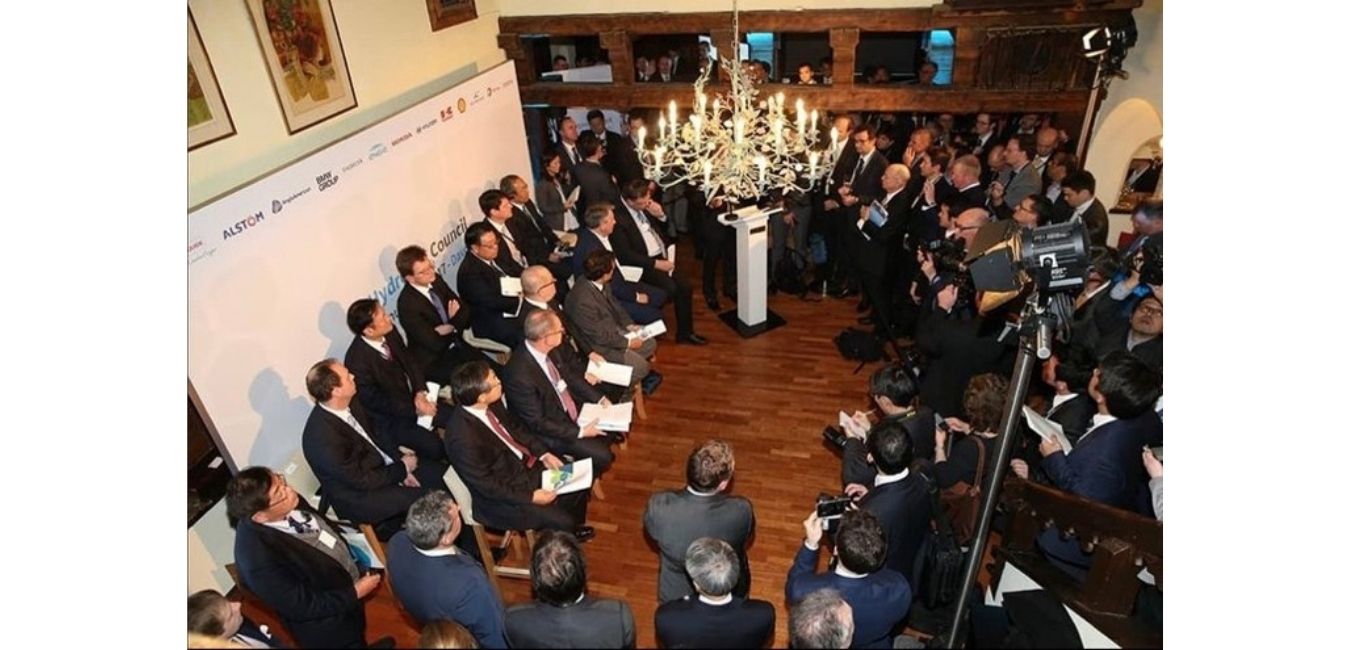
The Bridge Tank is invited to the launch of the Hydrogen Council at the 2017 Davos Forum

On the 17th of January 2017,  the Hydrogen Council was launched as part of the Davos Forum, inaugurated by Dominic Waughray, Senior Director and Head of Environmental Initiatives of the World Economic Forum. The Bridge Tank, the only think tank to be invited to the event, was represented by out president Joël Ruet. Raphaël Schoentgen, board member and also Chief Technology Officer of Engie, was also present. This meeting was the first of its kind and at its level held to discuss challenges and opportunities ahead for hydrogen technologies. Among the influencers and CEOs present were Bertrand Picard, Chairman of Solar Impulse, as well as the CEOs of Total, Air Liquide, Kawasaki, Shell, Toyota, Linde, BMW, Engie, Daimler, Honda, Hyundai.

The first global initiative of its kind, the ‘Hydrogen Council’ aims to position hydrogen among the key solutions of the energy transition. Hydrogen, a versatile energy carrier with favorable characteristics, does not release any CO2 at the point of use as a clean fuel or energy source, rendering it therefore an important player in the transition to a clean, low-carbon, energy system. Hydrogen technologies and products have significantly progressed over past years and are now being introduced to the market. The Council will work with, and provide recommendations to, a number of key stakeholders such as policy makers, business and hydrogen players, international agencies and civil society to achieve these goals.

During the launch, members of the ‘Hydrogen Council’ confirmed their ambition to accelerate their significant investment in the development and commercialization of the hydrogen and fuel cell sectors. These investments currently amount to an estimated total value of €1.4 Bn/year*. This acceleration will only be possible if the key stakeholders increase their backing of hydrogen as part of the future energy mix with appropriate policies and supporting schemes.

Summary of Side Event “Structuring New Markets Linked to Climate Change: South-South Business Models for After the COP22”

The Side Event “Structuring New Markets Linked to Climate Change: South-South Business Models for After the COP22”  was organized in the Green Zone of the COP22 on November 16, 2016. The speakers included: Thomas Eymond-Laritaz, Director – APCO Global Solutions (Moderator); Abdeldjellil Bouzidi, Economist, Manager at Emena Advisory, Member of the Public Statistics Authority (France); Catherine Girard, Expert Leader, Energy and Commodities Strategy, Renault; Joël Ruet, Chairman – The Bridge Tank.

This side event, introduced by Thomas Eymond-Laritaz, provided an opportunity to discuss the impact of climate change and the COP21 and COP22 on the economic and industrial sectors. A particular focus was the perspective of innovative business models created in the South-South dynamic. The idea was to anticipate future opportunities, reflect on the structuring of new and green industrial ecosystems, and examine the financial tools that will enable progress in these two areas.


Read More…


Theme: Overlay by Kaira
Copyright 2020 - The Bridge Tank